
Strength Training vs. Personal Training: What’s the Difference and Which One Do You Actually Need?
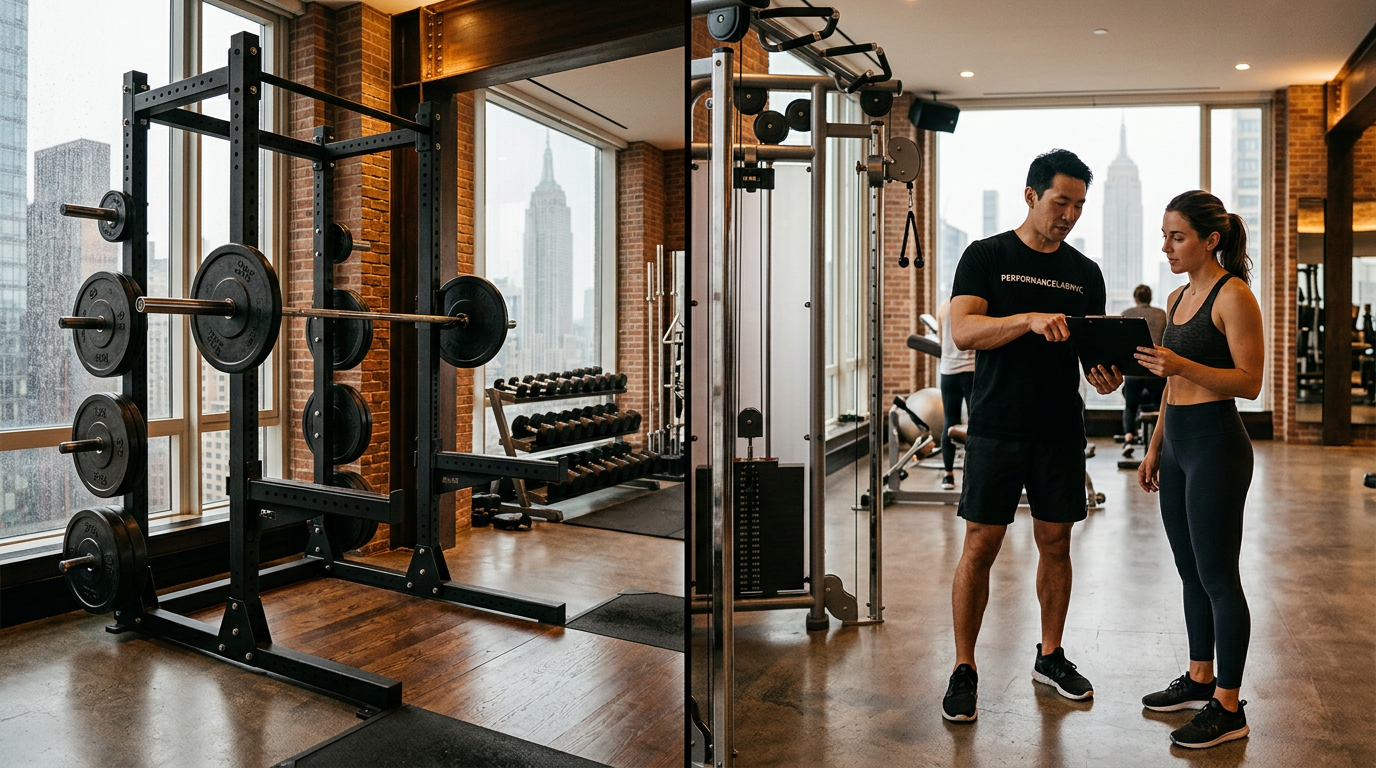
Comparison of self-directed strength training equipment and one-on-one personal training session inside a luxury NYC residential fitness facility
If you’ve been searching for the right fitness approach and found yourself going back and forth between “strength training program” and “personal trainer,” you’re not alone. It’s one of the most common points of confusion for people who are serious about getting results but haven’t fully committed to a direction yet. The good news is that once you understand what each actually means, the answer usually becomes clear quickly.
What strength training actually is.
Strength training is a category of exercise. It refers to resistance-based work – using weights, cables, bodyweight, or other load-bearing methods – designed to build muscular strength, endurance, and in some cases, hypertrophy. A strength training program in New York City can mean a lot of things: a barbell program you follow from an app, a structured lifting plan from a coach, group classes built around weighted movements, or sessions you design yourself based on what you’ve read or watched online.
Strength training is valuable. The science behind it is well-established. Regular resistance work improves body composition, bone density, metabolic function, hormonal health, and functional capacity well into later life. Anyone who tells you otherwise is wrong.
But here’s the limitation: a strength training program is a method. It tells you what to do. It doesn’t assess who you are, how you move, what your history is, or where your specific gaps and risks lie. That’s the gap that personal training fills.
What personal training actually is.
Personal training is a relationship built around you specifically. A qualified personal trainer doesn’t just prescribe exercises – they assess your movement quality, understand your injury history, account for your schedule and recovery capacity, and build a program that’s calibrated to your physiology and your goals. One-on-one training in NYC at the level we deliver it at Performance Lab isn’t just supervised exercise. It’s applied exercise science with a human being accountable to your outcomes.
The distinction matters because two people can do the same strength program and get completely different results, or one can get injured and the other doesn’t, simply because of differences in movement mechanics, mobility, or training history that a generic program never accounts for.
When strength training alone is enough.
If you have solid movement foundations, a clear understanding of your body, genuine experience with resistance training, and the discipline to program and progress yourself, a well-designed strength training program can absolutely serve you. There are people who thrive in that model. It requires self-awareness, consistency, and an honest read on your own limitations.
When personal training is the smarter investment.
For most people, and particularly for those navigating busy lives, returning to training after time away, managing any history of injury, or simply wanting to compress the timeline to results, a personalized fitness program in New York City with a qualified trainer is the higher-leverage choice. You eliminate the guesswork. You get accountability. You get progression that adapts as you do.
For residents looking for a personal trainer in a luxury building in NYC, the additional advantage is that the barrier to consistency is almost entirely removed. The expertise is in your building. The session is already scheduled. The only variable left is showing up.
How Performance Lab approaches it.
At Performance Lab, personal training NYC isn’t a standalone service sitting next to a gym membership. It’s the core of an integrated program that includes assessments, nutritional guidance, massage therapy, and recovery protocols, all operating as a single system. The strength work is periodized and purposeful. But it exists inside a larger framework designed to produce results that hold.
So which one do you actually need? If you want to get stronger, both can work. If you want to move better, recover faster, perform longer, and build something that lasts, the answer is a personalized program built around who you are and how you actually live.